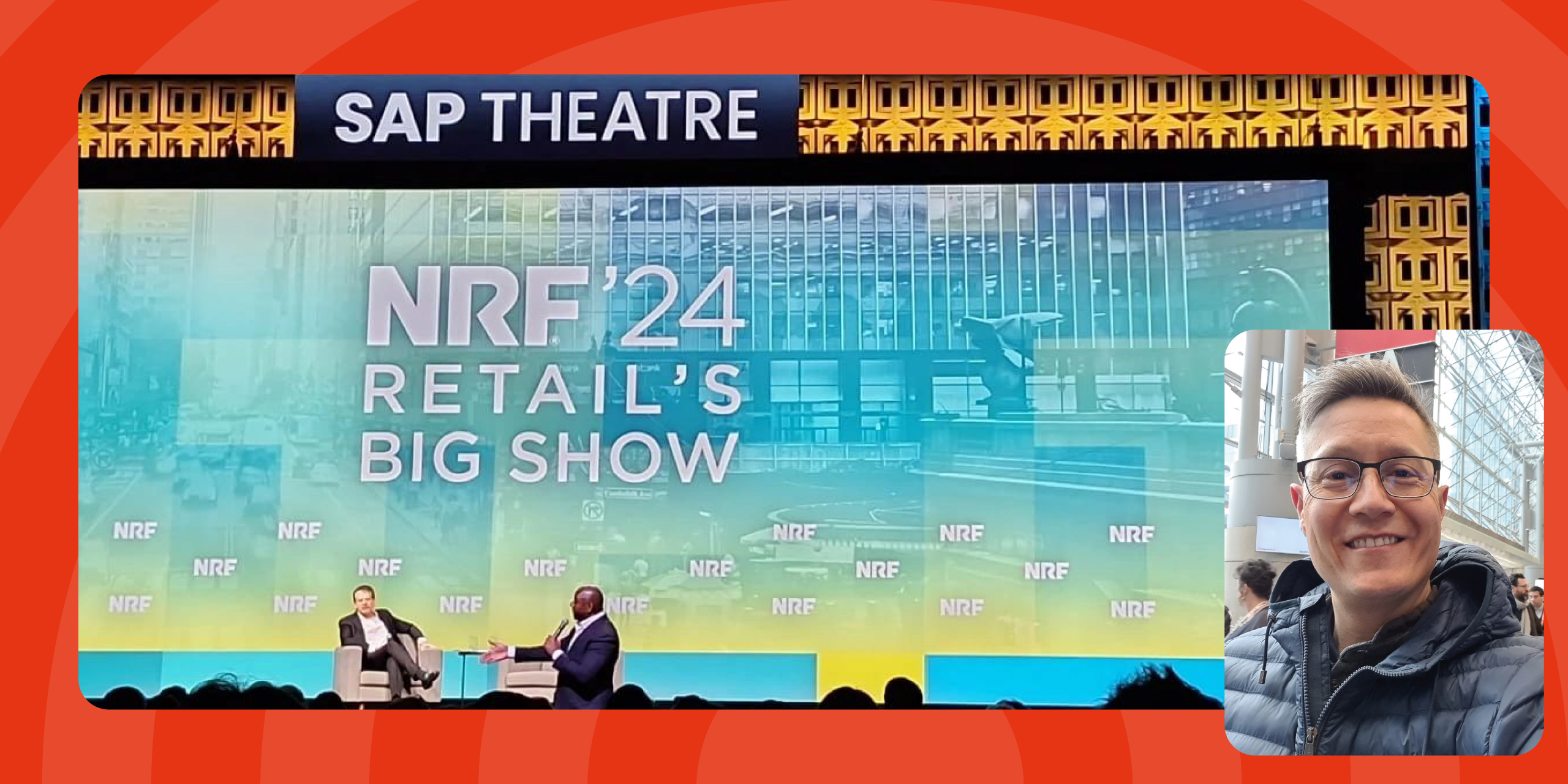


On the last day of NRF 2024, the focus ceased to be “trend in theory” and became “what already appears as a product and service on the stands”. The two fronts with the highest recurrence in demonstrations were Generative AI and Retail Media, with applications directly connected to operation, marketing, and in-store media.
What changed in NRF 2024 when the topic is offer ready
In previous editions, many discussions focused on promises of unbacked transformation in delivery. In 2024, most of the exhibitors presented functionalities applicable to specific routines, with a more limited scope and more pragmatic discourse about technical and data constraints.
Generative AI: where it's already working in retail
Generative AI appeared more frequently in cases related to content, conversation, and operational support based on textual knowledge. The concentration was evident in scenarios where knowledge is already organized in documents, conversations, and training materials.
Product content and description
Many vendors showed assisted product description generation, attribute standardization, and copy variations for e-commerce. This type of application tends to gain traction because it reduces registration time, increases catalog consistency, and speeds up message testing.
Service and chatbots with context
There was also a strong presence of chatbots and service assistants, with contextual answers based on knowledge bases. The value is clearer when there are audit trails, source control, and security mechanisms to prevent non-policy responses.
Marketing and communication pieces
Several solutions included the creation of pieces for campaigns, text variations for advertisements, and support for social and CRM teams. This usage block usually advances when the retailer defines brand governance, approvals, and limits on what can be automatically generated.
The current limit: reading metrics and private data
An attempt was made to position Generative AI as a layer for reading numbers and structured bases, including metrics and performance. In this NRF, this point appeared more as an ambition than as a mature product, mainly due to its dependence on reliable infrastructure for publishing and consulting private data, with access control and traceability.
Retail Media: from the in-store screen to data-driven planning
Retail Media appeared with demonstrations focused on media and audience within the physical environment, with emphasis on inventory management and the execution of in-store campaigns. The emphasis was greater on media operation and governance than on the full measurement of incrementality.
Centralized in-store media management
Several exhibitors presented platforms to control and distribute campaigns at multiple touch points in the store. This type of centralization reduces friction between areas, helps to standardize inventory, and makes it easier to execute with multiple brands.
Digital Signage returned for an operational reason
Digital Signage appeared with force, supported by the advancement of LED screens and various formats for spaces and gondolas. The practical gain lies in the flexibility to update messages, the organization of a campaign calendar, and the ability to segment content by store, area, or moment.
The gap: unify data and measure effect by channel
It is still rare to see a case that uses the database in an integrated and consistent way across all approach channels, connecting exposure, audience, execution, and result. Maturity increases when the operation manages to associate campaign with audience, context, and impact on the sell-out, with clear rules for attribution and data quality.
Adjacent trends seen in NRF 2024
In addition to Generative AI and Retail Media, three themes appeared as “side lines” that should gain density as costs and operating models mature.
Robotics with AI and task automation
Robotics appeared with a narrative more oriented to complete tasks, including the replacement and movement of items, with a focus on efficiency and safety. Adoption tends to depend on economic viability, capital availability, and return calculation in intensive operation scenarios.
Augmented reality and assisted experiences
Augmented reality appeared to support training and assistance in specific activities, with less emphasis on entertainment. The practical value is usually clearer when there is a process with recurring errors, high onboarding time, or the need for operational standardization.
Self-checkout and journey efficiency
Self-checkout continued as a relevant topic due to its direct impact on queues, productivity, and the perception of convenience. The most useful discussion usually involves journey design, loss prevention, and integration with payment and loyalty methods.
What this means for the retailers' and vendors' roadmap
For Generative AI, the main decision point is governance: authorized sources, security, auditing, and integration with real workflows. For Retail Media, the critical point is measurement and unification of data for planning and proof of results, including in-store operation and integration with digital channels.
Frequently Asked Questions (FAQ)
What was the most “ready product” in NRF 2024?
Generative AI applied to content and service, in addition to Retail Media solutions for in-store media execution and management.
Is Generative AI ready to analyze private retail metrics and data?
There is interest and prototypes, but maturity depends on data infrastructure, access control, traceability, and governance.
Retail Media at NRF 2024 was stronger in which formats?
The biggest presence was in centralized media management within the store and Digital Signage with more flexible execution.
Do retail robots already do replacement and complete tasks?
There are demonstrations and capacity developments, but adoption at scale depends on CAPEX, ROI, and suitability to the operating environment.