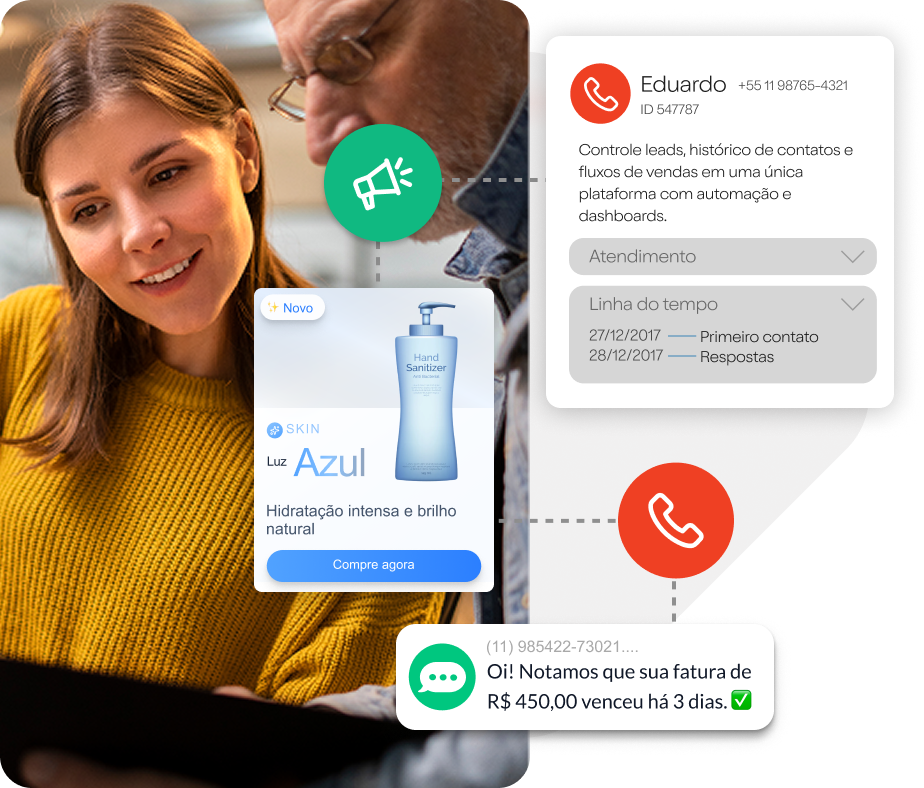


Consumer expectations have risen because access to digital channels is immediate and constant. This increases the charge for quick responses, continuity of service, and personalization at any point of contact. In this scenario, an omnichannel chatbot becomes relevant when it manages to unify conversations between channels and maintain the context of the customer's history.
An omnichannel chatbot is a solution for Conversational AI which serves on multiple channels (website, app, WhatsApp, social networks and others), with the ability to transfer the conversation from one channel to another without losing essential information. This model reduces friction in the journey, because the customer doesn't have to repeat data when switching channels.
Based on Plusoft's experience at scale of operation, we have put together 4 practical benefits which usually have a direct impact on working hours, productivity and costs.
1) 24/7 availability with operational scale
Continuous service reduces queues during peak hours and gives rise to demands outside the office. An omnichannel chatbot supports this operation with Capacity for simultaneous conversations, keeping the history integrated with the channels.
Practical impact on the operation
- Reduction of waiting time for recurring contacts (order status, duplicate, frequent questions).
- Absorption of seasonal peaks without proportional staff hiring.
- Less loss of opportunity in contacts outside business hours.
Typical example: a customer requests support on the site in the evening and resumes on WhatsApp in the morning; the context of the case remains available, avoiding a restart of the service.
2) Continuity of experience between channels
An omnichannel journey depends on context persistence: subject, customer data, stage at which the conversation stopped, and referrals already made. When the conversation is complete across channels, the experience is more consistent and tends to increase satisfaction.
What improves on the journey
- Less repetition of information by the customer.
- Resuming conversations from the correct point (intent and status).
- Transfer to a human agent with context, reducing screening time.
Typical example: the customer starts on Instagram, switches to WhatsApp to send a receipt and ends in human service; the history accompanies the transitions.
3) Cost efficiency and team focus on complex cases
When the chatbot solves predictable demands and screenings, a relevant part of the volume stops reaching the human team. This reduces the cost per contact in high-volume scenarios and opens space for agents to act on exceptions and sensitive deals.
How does this appear in the numbers
- Decrease in the volume of single tickets.
- Increased productivity per agent in more complex cases.
- Better team allocation in retention, negotiation, churn prevention, and specialized support.
Good practices that enhance earnings
- Flows designed with clear objectives (solve, forward, collect data).
- Handover rules for humans when there is low trust, recurring error, or explicit request.
4) Personalization with real-time multi-channel data
An omnichannel chatbot can collect behavioral signals and preferences from interactions on different channels. Personalization works when that data feeds answers and next steps based on context.
Effects on the CX journey
- Fewer steps to complete requests (data already available).
- Recommendations and guidelines that are more in line with the customer's history.
- Increased conversion in purchase flows and post-sale resolution.
Typical example: after previous interactions about a product, the chatbot recognizes the category, retrieves recent orders and redirects to the most probable path (exchange, support, warranty), with objective collection of information.
How to measure if the omnichannel chatbot is generating results
Measurement guides the prioritization of improvements and evidences return. For operation and CX, these indicators are often the most useful:
- Bot resolution rate (containment): percentage of conversations closed without a human agent;
- Average service time (TMA): considering bot and human, with cutouts per channel;
- FCR (First Contact Resolution): resolution at first contact, with attention to cases that migrate from channel;
- CSAT/NPS per day: compare experiences with and without transshipment to human;
- Contact reasons and intent coverage: which intentions appear the most and which have the greatest lack of understanding;
- Abandonment rate by stage: identify friction points in forms and data collections.
Quick checklist to implement with less rework
- Map of priority journeys: 5 to 10 streams with high volume and clear resolution rule;
- Standardized knowledge base: answers, policies, and exceptions in consistent language;
- Essential integrations: CRM, orders, registration, service status and authentication when applicable;
- Handover governance: criteria for transferring and registering the context to the agent;
- Continuous monitoring: low-performance intents, new terms, and language variations by channel.
Omnichannel chatbot: how to connect channels, gain 24/7 scale and reduce operational burden with transshipment governance
An omnichannel chatbot tends to generate more results when it connects context between channels, maintains 24/7 scale, reduces the operational burden of the human team, and uses interaction data for personalization. These gains appear more consistently when the implementation includes metrics, integration with service systems, and transshipment governance.
Do you want to evaluate the best design for your operation? Include the omnichannel chatbot in your CX plan and map the flows with the highest volume and impact on customer satisfaction.
Frequently Asked Questions (FAQ)
What is an omnichannel chatbot?
It is a chatbot that serves multiple channels and maintains the history and context of the conversation, allowing continuity when the customer changes channels.
What areas are omnichannel chatbots good for?
Service, support, SAC, sales, after-sales, and retention tend to be the areas with the greatest impact, especially in high-volume operations.
Does an omnichannel chatbot replace human service?
It assumes repetitive demands and screenings; complex, sensitive, or non-standard cases follow with agents, with transferred context.
What channels are usually integrated?
Website, app, WhatsApp, Instagram, Messenger and other digital channels, according to the service stack and public demand.
What metrics indicate success?
Bot resolution rate, TMA, FCR, CSAT/NPS per journey, and reduced abandonment at critical stages often signal an impact.