

Recent years have accelerated changes in retail, with the expansion of digital channels and operational adjustments to maintain sales and service levels. A survey released by SBVC in March 30, 2021 pointed 21% growth among retailers that bet on digital transformation and registered progress for 57% in the share of companies that treated digital transformation as a strategic priority, with a defined plan and investments.
In food retail, where the purchase frequency tends to be high and the basket is context-sensitive (price, convenience, replacement, and preference), personalization impacts objective decisions: reducing friction, increasing recurrence, and directing money to actions that are more likely to convert.
What does “personalise” mean in food retail
Personalization, here, is adjusting offer, message, channel and timing based on customer signals and the timing of the journey. This includes everything from a replacement coupon to the continuity of service when the consumer migrates from WhatsApp to the store and then to e-commerce.
Why personalization became a requirement in the buying journey
- More channels, more breakpoints
When the customer switches between store, app, website, delivery and service, the experience loses consistency if each channel “sees” a different customer. - Expectation for relevance rather than promotion volume
Generic promotion tends to generate waste of money and communication saturation, especially in recurring purchase categories. - Data already exists; the challenge is to connect it
POS, e-commerce, loyalty club, SAC and campaigns create useful signals, as long as they are unified and activated.
What data to use to accurately customize
Most common sources in food retail
- POS transactions: items, frequency, schedule, ticket, mix.
- Loyalty club/CPF: stable link for history and segmentation.
- E-commerce and apps: navigation, lists, abandonment, delivery/pickup preference.
- Attendance: contact reasons, order status, recurring complaints.
- Geography and preferred store: buying radius and sensitivity to convenience.
Data quality criteria (for practical decision)
- Resolved identity: the same recognized customer on more than one channel.
- Frequent update: short windows for perishables and replacement.
- Consent and governance: consent trail and LGPD policies applied to use in campaigns.
Personalization tactics that work for grocery stores and atacarejos
1) Replenishment per purchase cycle
Use frequency by category to trigger communication when the likelihood of replacement increases.
Example: those who buy coffee weekly are offered within the typical repurchase interval, with variation by brand and price range.
2) Segmentation by buying mission
Group customers by basket pattern: “supply of the month”, “quick purchase”, “vegetable basket”, “pet”, “children”.
Direct implication: campaigns stop competing for attention in the same format and start using different creatives and channels.
3) Personalization for price and brand sensitivity
Classify customers by observable elasticity (brand change in promotion, category migration, ticket variation).
Application: higher discounts only where there is a risk of churn or replacement, preserving margin on the rest.
4) Cross-sell recommendations with basket context
Suggestions must respect the purchase mission.
Example: in a barbecue basket, offering charcoal, ice and associated beverages tends to increase conversion more than a generic recommendation for “best sellers”.
5) Post-purchase experience as a recurrence lever
Activate useful transactional messages: separation confirmation, delivery window, item replacement, exchange, and return. This reduces contacts in the SAC and improves repurchase.
Omnichannel: where personalization is supported
Personalization depends on continuity. The research cited by SBVC also indicated investment direction for omnichannel and e-commerce among the main fronts adopted by retailers in the period.
In subsequent editions of the study, with repercussions on the sector, omnichannel and consumer experience appear as relevant investment focuses, reinforcing that operational integration and unique customer vision are conditions for scaling personalization.
What needs to be integrated (without operational ambiguity)
- Shopping cart and order: start in the app and finish on the site, with the same price and availability.
- Customer identification: CPF/ID and accessible service preferences.
- History of interactions: complaints and returns influence offers and approach.
- Inventory by store: essential for click and remove, replacement, and promise of delivery.
Have the right technology as an ally
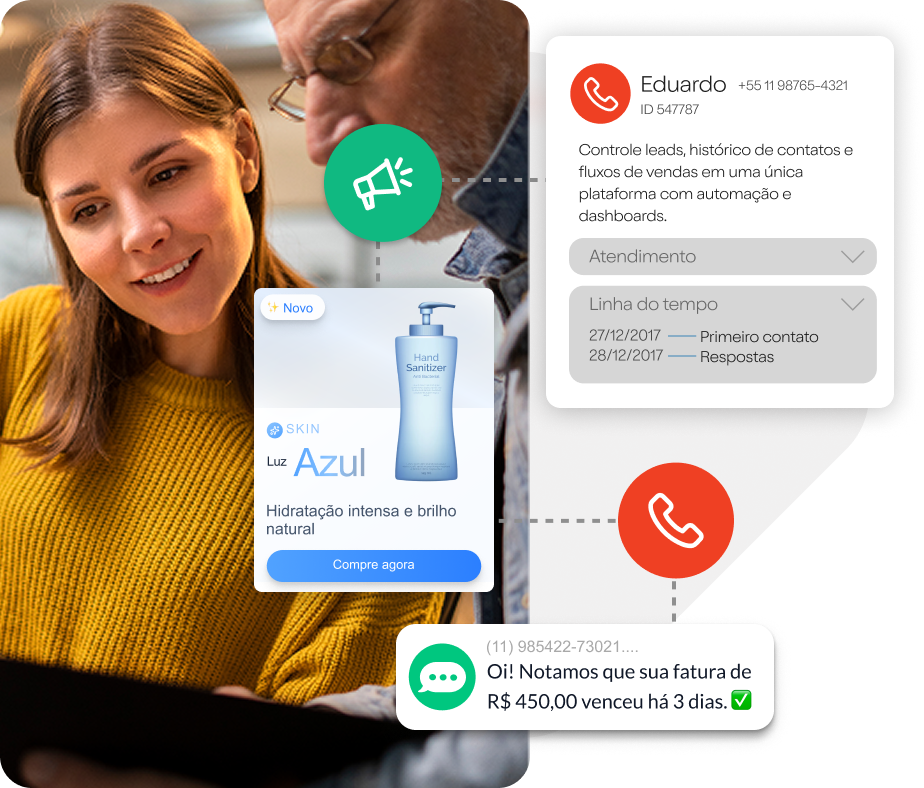
CRM and automation
A robust CRM allows you to:
- unify history and consent,
- create actionable segments (not just reports),
- trigger days per event (purchase, abandonment, replacement, anniversary, exchange).
Chatbots and automated service
In food retail, chatbots generate direct gain when operating in high-volume flows:
- order and delivery status,
- availability and replacement policy,
- duplicate, cashback and club rules,
- screening for human care with context already collected.
The evaluation criterion is objective: reduction in average response time and increased resolution at the first contact, with the transfer of the history to the attendant when there is an appointment.
How to start a personalization project in food retail
- Choose 2 measurable objectives: repurchase within 30 days, ticket increase, coupon redemption, reduction of contacts per order.
- Define the identity key: CPF, app login, telephone (WhatsApp), or combination with resolution rule.
- Map 3 priority data sources: POS + loyalty + e-commerce (typical example).
- Create 5 initial segments: recurring, at risk, high ticket, sensitive to promotion, “supply” mission.
- Implement 3 days: replacement, reactivation, transactional post-purchase.
- Standardize metrics by channel: open/click, conversion, incremental ticket, incremental margin.
- Establish contact limits: maximum frequency per week and message priority rule.
Metrics that show if personalization is working
- Repurchase rate (D+7/D+30) by segment.
- Ticket increase and margin in personalized campaigns vs. control.
- Redeem offers by category and purchase mission.
- Adherence to the preferred channel (WhatsApp, push, email) per profile.
- Contact by request and First-time resolution.
Next steps
If your main challenge is to ensure continuity between physical store, e-commerce and service, the omnichannel strategy tends to be the first step in enabling personalization at scale.
To assess your operation scenario, integration priorities, and expected impact, talk to a Plusoft specialist.