

A Brazilian company in the health sector, recognized for the quality of its customer service, faced an operational bottleneck on the “Contact Us” channel by e-mail. The average volume was about 2,500 cases per month, which increased the public's waiting time to about 4 days. This scenario increased team overload, reduced the predictability of the SLA, and increased the risk of rework due to lack of centralized history.
Objective of the project
The project sought three measurable operational results:
- Reduce response time and improve the perception of service.
- Absorb peaks in demand without expanding the team proportionately.
- Centralize customer history and data to increase resolution and enable continuous improvement.
Solution implemented with CRM and AI
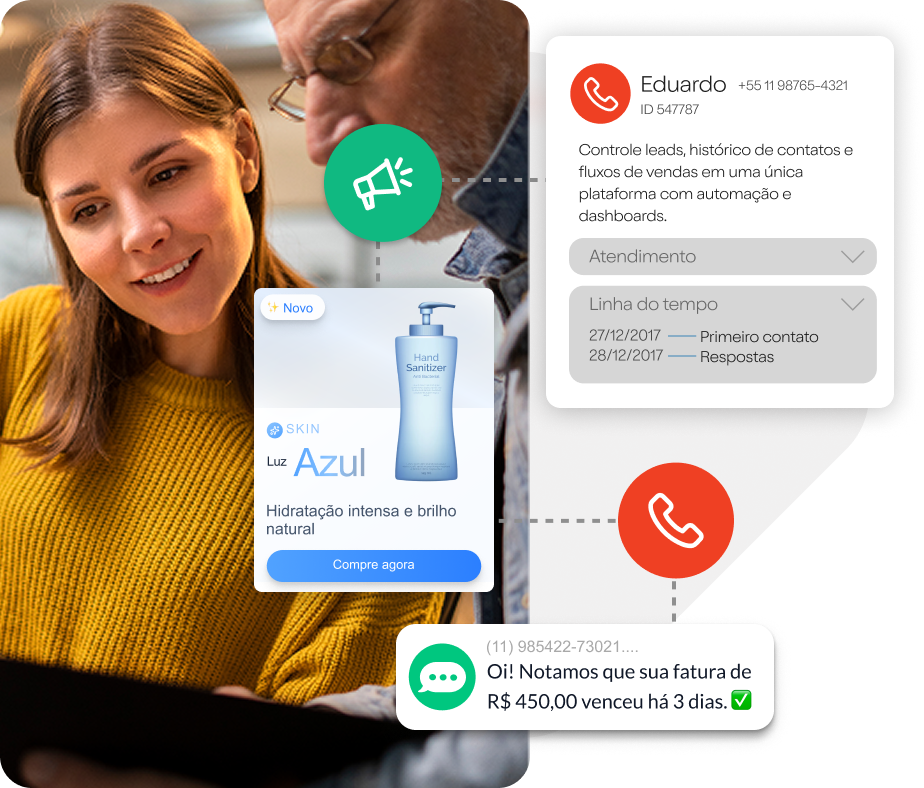
The company adopted a integrated platform with CRM and a virtual assistant (chatbot), available 24 hours a day, 7 days a week, with automation oriented to use cases and registration of interactions in the CRM. The architecture prioritized scalability, traceability, and standardization of deals.
24/7 virtual assistant and knowledge base
The virtual assistant was designed to respond quickly and consistently to recurring requests. The knowledge base was structured to keep answers updated, reduce ambiguities, and sustain evolution through improvement cycles, using intent data, most sought after terms, and abandonment points.
Integration and unique history in CRM
The integration with CRM made it possible to record each interaction as an event linked to the customer, preserving context between channels. This design reduced information losses between e-mail, chat, and human service, in addition to supporting reports due to contact, recurrence, journey, and performance per queue.
Flows with routing for attendants
For demands that required human analysis, the system applied routing for the team with categorization of the reason, capture of essential data and history already attached to the case. This flow reduced screening time and improved the quality of responses, because the attendant received the context before the first contact.
Automated use cases
Automation was prioritized by volume and impact on service time. Among the main automated routines, the following stood out:
- Clarification of frequently asked questions with standardized answers.
- Opening requests with guided information collection.
- Scheduling appointments according to service rules.
- Update of registration data with validations in the flow.
- Making payments and guidance for the necessary steps.
- Issuance of guides and tickets with step-by-step guidance.
Results and indicators
The operation showed objective gains after implementation:
- 56% increase in monthly deals: from 2,510 towards 5,668 negotiations per month, supported by 24/7 availability and the automation of high recurrence cases.
- Retention rate above 90%: 92% in January 2024, 90.7% in February and 94.6% in March, associated with greater agility and increased resolution in the journey.
- 92% reduction in human effort: repetitive tasks began to be absorbed by automation, freeing the team for more complex analyses, exceptions and negotiations.
These results tend to improve when the knowledge base is continuously maintained, when data flows are adjusted to reduce missing fields, and when contact reasons are reviewed with governance.
Impact on the team and customer experience
The operational impact appeared on three fronts that influence management decisions:
- Customer satisfaction and engagement: the reduction of waiting time increases the perception of care and reduces recontacts due to lack of feedback.
- Team productivity: with less manual screening and fewer repetitive tasks, the attendant starts to operate activities with greater value and less wear and tear.
- More efficient use of resources: well-designed automation reduces the cost per contact and opens space to invest in service improvements and new channels.
Specific health challenges and solutions
Health care requires care with sensitive issues, appropriate language, and correct referral. For this reason, the virtual assistant was configured with rules for:
- Identify urgent requests and guide the client to the most appropriate path according to the internal protocol.
- Targeting complex cases to human care, with prior data collection to reduce back and forth.
- Ensure traceability in the CRM, allowing auditing and review of the journey.
This type of design reduces inconsistencies, improves service quality, and facilitates adjustments based on real operating data.
What does this case teach for health care operations
This case points to practical criteria for similar decisions:
- Choose use cases by volume and average service time accelerates the ROI of automation.
- Unify history in CRM avoids rework and improves resolution in the first response.
- Measure retention, human effort, and negotiations creates a management panel with a direct impact on cost, SLA, and experience.
- Maintain content governance the knowledge base supports gains over time.
Next steps
If your operation faces high volume in “Contact Us”, long queues, or low standardization between channels, the combination of CRM + IA tends to generate gains when there is prioritization by case, data integration, and clear metrics from the start.
Do you want to evaluate a journey design with automation and CRM applied to your scenario? Contact the Plusoft team to map use cases, integrations, and success indicators.