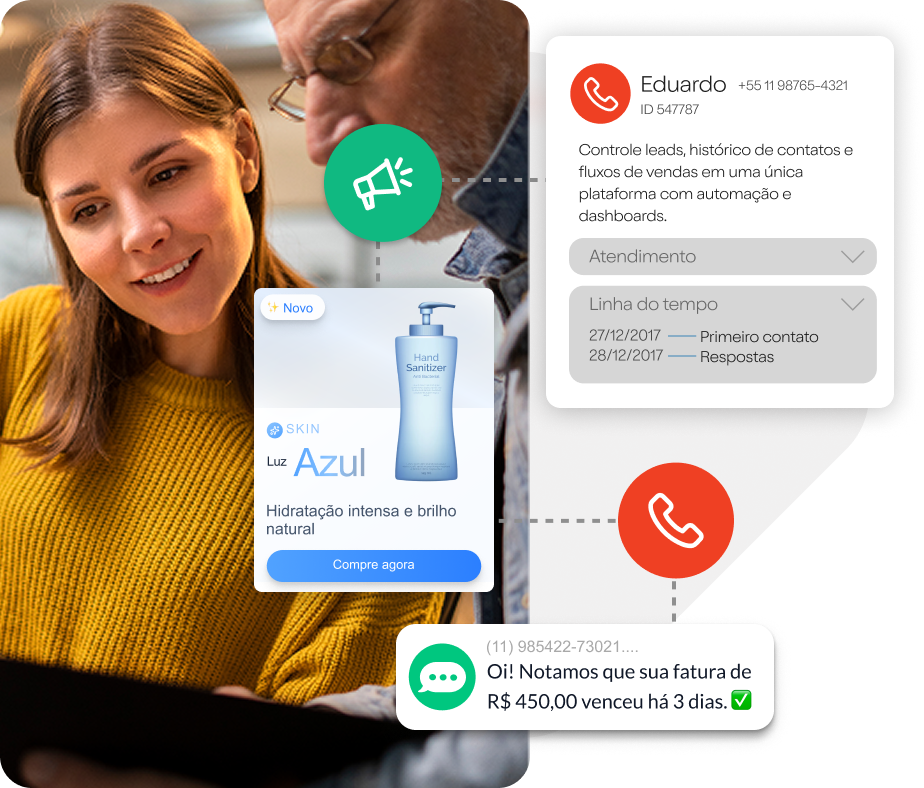


With the changes in the WhatsApp Business Platform billing, the support design influences cost, service time, and resolution at the first contact. In July 1, 2025, Meta started to move forward to billing per message (template message) in categories such as Marketing and Utility, progressively replacing logic with a conversation window in many scenarios.
In parallel, there were movements to reduce barriers to receptive care, such as initiatives of Meta exemption from charging for customer-initiated service conversations in previous phases (ecosystem communications indicate November 2024 as a milestone).
The practical effect is that efficient support depends on two fronts: reducing repetitive contacts (self-service) and conducting human contact only for cases of greater value or complexity.
1) Structure a knowledge base that solves before WhatsApp
A knowledge base reduces the volume of tickets and improves the quality of the messages that arrive on WhatsApp.
What to prioritize in your FAQ and help articles:
- Delivery and deadlines: status, tracking, delays, delivery attempts;
- Exchanges and returns: rules, deadlines, step by step, documentation;
- Payment and invoice: forms, common faults, duplicate, reimbursement;
- Use of the product/service: installation, first steps, frequent errors;
- Policies: warranty, support, cancellation, terms.
How to connect this to WhatsApp:
- Use quick answers with links to specific articles;
- Standardize “decision points” in the flow: when to send a link, when to collect data, when to scale;
- Keep the database updated based on weekly reports of contact reasons (Top 10) and terms searched on the site.
2) Publish informational content that works as “shortcuts” in service
Editorial content reduces friction when answering recurring questions with a unique, trackable link.
Types of content that directly help support:
- “How to track my order”
- “How to request exchange in X steps”
- “What to do when payment fails”
- “How to update registration and address”
- “Information checklist for opening a call”
Operational requirement for this content to generate savings:
- Each post must have a support objective, um stepwise And a Self-service CTA (ex.: form, logged in area, tracking).
- Each link used on WhatsApp must have Specific UTM to measure impact on service volume and average resolution time.
3) Use video tutorials to reduce back-and-forth and accelerate understanding
Video reduces the exchange of messages when the problem involves visual procedure (configuration, installation, use of an app, assembly, document validation).
Typical applications:
- “How to reset password”;
- “How to enable notifications”;
- “How to install and configure”;
- “How to collect evidence (photos/prints) for support”.
Best practices for video to work on WhatsApp:
- Start with The expected result (what will be solved);
- Use short chapters (30—90 seconds per step) to facilitate resubmission;
- Host on your own page with complementary text, for indexing and to reduce dependency on external platforms.
4) Adopt chatbot automation and template governance to control cost and quality
Chatbot improves response time and reduces human burden when it performs screening, collects data, and solves simple items. It also helps to avoid unnecessary triggering of paid templates when pricing depends on the type of message sent.
Practical checklist of what to implement:
- Intent screening (delivery, payment, exchange, technical support, call status);
- Structured data collection before going to human (CPF/CNPJ, order number, e-mail, evidence);
- Routing by rule (queue by topic, priority by SLA, VIP, churn risk);
- Explicit human scaling at friction points (second failed attempt, undue charge, reputational risk);
- Template library with governance:
- Correct classification (Utility/Marketing/Authentication/Service, according to BSP and WhatsApp Manager rules);
- Lean content, with well-defined variables, to reduce resubmission;
- Reuse policy: when to respond to the service within the service window, when to activate the template.
- Metrics that need to exist: bot containment rate, FRT (first response time), FCR (first contact resolution), CSAT, contact reasons, and cost per resolution.
WhatsApp in support: execution and governance
If WhatsApp support is treated as an execution channel (and not just a conversation channel), you reduce volume, increase predictability, and improve experience. The four actions above work like a system: knowledge base decreases demand, content and video accelerate understanding, automation filters and resolves, and template governance avoids avoidable costs under models that are charged per message.