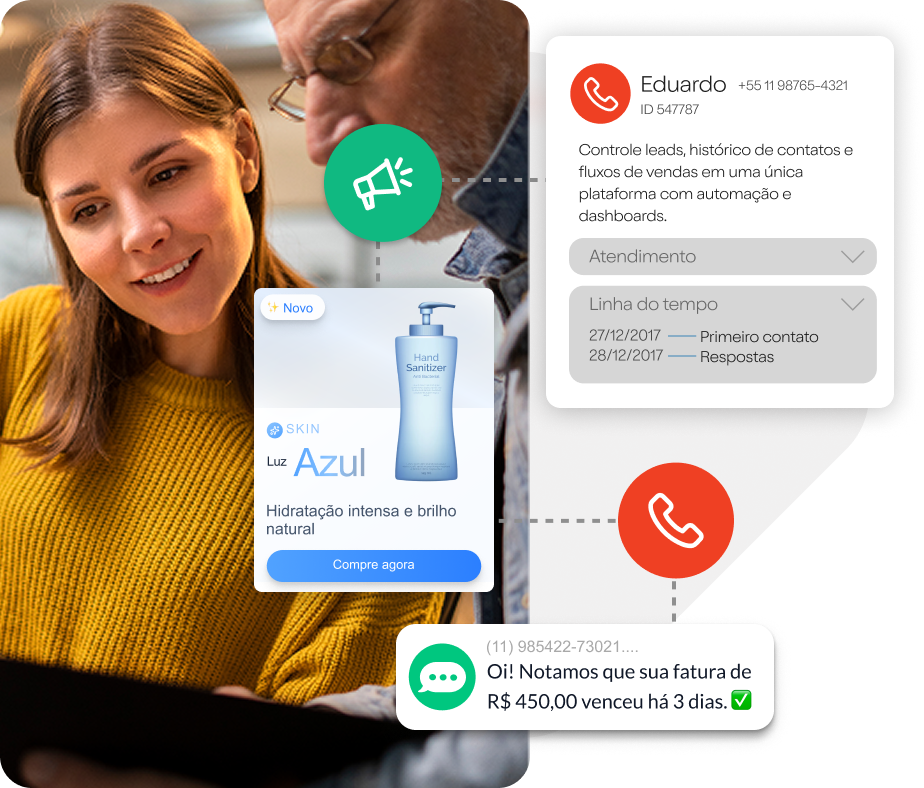


In retail and consumer goods, the customer journey concentrates repetitive requests (tracking, deadlines, exchanges, availability) and sensitive moments for revenue (cart abandonment, rupture, repurchase). A well-implemented chatbot absorbs the volume of predictable questions, records context data, and reduces friction at the points that impact conversion and cost of service.
The digital transformation in these industries has advanced with a focus on data, automation, and artificial intelligence. An EY study on retail transformation describes accelerating plans for digitization and prioritization of analytics, AI, robotics, and automation as relevant areas of investment and intent.
What is a chatbot
Chatbot is a conversation software that serves customers through digital channels, following defined flows and, in some cases, using artificial intelligence to interpret language variations.
In practice, there are two common formats:
- Flow-based chatbot (closed cycle): better meets predictable requests, with guided questions and standardized answers;
- Chatbot with AI (PLN/LLMs): expands language coverage, reduces dependence on buttons, and improves intent classification when there is a knowledge base and continuous curation.
The choice of format depends on the mix of demands, operational risks (exchanges, payments, personal data) and the level of integration with internal systems.
Why chatbots are a good fit for retail and consumer goods
The demand for conversations with brands in messaging apps tends to focus on “asking questions/asking for information” and “receiving technical support”, among other purposes. In the report Panorama Mobile Time/Opinion Box — Messaging in Brazil (Feb/2022), “ask questions/ask for information” appears with 79% on WhatsApp and “receive technical support” with 69% on WhatsApp, within the purposes considered appropriate for speaking with companies via messaging.
This creates a scenario in which a well-designed automated layer reduces the human queue and improves response time on recurring themes, provided that there is consistent routing for attendants when the case requires an exception.
5 benefits of the chatbot in retail and consumer goods
1) Low-friction adoption because the public is already using the technology
Research published by Userlike recorded that 80% of respondents have already interacted with a chatbot.
This data reduces the risk of rejection due to channel alienation and allows you to concentrate effort on conversational UX, clarity of scope, and handoff for humans.
Practical example: tracking service and delivery time via WhatsApp, with scheduling to human when there is a divergence of address or logistical occurrence.
2) Unification of history and context when integrated with CRM and CDP
When the chatbot records identification, preferences, requests, and contact reasons on a single basis, the company gains objective conditions to segment communications, reduce rework, and measure recurrence by reason.
The operational gain depends on real integration with CRM/OMS/ERP, because isolated data in the channel did not become actionable intelligence.
Practical example: when authenticating the customer, the bot consults the order status in the OMS and records the reason for the contact in the CRM, allowing analysis by SKU, region, carrier, and category.
3) Service automation with data trail for continuous improvement
Automation delivers efficiency when instrumentation exists: intent, resolution rate, fallback reasons, time to handoff, and recontact reasons. This set guides knowledge base curation and the prioritization of integrations.
An excerpt from retail executives in McKinsey's research on GenAI points to efforts to scale use cases and reinforces the dependence on organizational capacity, data, and implementation to move forward.
Practical example: automated “exchange and return” with rules by category and return window, generating a weekly report of return causes for the selected reason.
4) Continuity of purchase and recovery of revenue on interrupted journeys
In retail, conversations often begin with support and end in a purchase decision. If the bot identifies an abandoned cart, stock shortage, or specification question, it can provide continuity with context, as long as it respects consent and channel rules.
Practical example: The customer asks about the deadline; the bot answers with a zip code, offers the option to “finalize the shopping cart” and sends a checkout link with tracking.
5) Personalization of offers and recommendation based on history
When the chatbot accesses purchase history and preferences (with consent), it becomes a recommendation point with better timing than a generic banner.
Effectiveness increases when recommendations follow simple rules: repurchase per cycle, complementary by category, and substitutes in case of rupture.
Practical example: after authentication, the bot suggests the replacement of recurring items and presents an incentive to experiment in an adjacent category, with a frequency limit to avoid saturation.
What to evaluate on a retail and consumer goods chatbot platform
Prioritize criteria that change operating results:
- Native or API integrations with CRM, CDP, OMS, ERP, payment gateway, logistics and catalog.
- PLN in Portuguese with support for regional variations and intent by domain.
- High resolution at first contact, measured by FCR (First Contact Resolution) and quality containment.
- Handoff for human with context, including history, order data, and detected intent.
- Curation layer to review intents, train base, adjust flows, and control hallucinations in generative AI.
- Construction flexibility (flows, rules, catalogs, forms, lists, and buttons) to reduce technical dependency.
- Governance and compliance (LGPD, logs, access controls, retention policy, and data masking).
Recommended implementation: project vision
- Mapping contact reasons by volume, criticism, and impact on revenue.
- Definition of automation scope with clear exception rules and scheduling criteria.
- Minimum feasible integrations: authentication, order consultation, delivery status, exchange policy, and catalog.
- Content and knowledge base with official source, version and responsible.
- Test with real sample of conversations and daily monitoring of failures in the first few weeks.
- Continuous improvement routine based on unanswered intents, handoff reasons, and recontact within 7 days.
KPIs that help you decide if the chatbot is performing
- FCR (first-contact resolution) by reason.
- Containment Fee with quality auditing (unresolved containment generates recontact).
- Time until first response and Time until resolution.
- Handoff rate by intention, to detect poorly designed flows or lack of integration.
- CSAT post-service separated by “solved bot” and “human after bot”.
- Assisted recipe (cart retrieval, upsell, repurchase) with consistent attribution.
Frequently Asked Questions (FAQ)
Is Chatbot suitable for WhatsApp in retail?
It works when there is authentication, integration with order data, and clear scheduling rules. WhatsApp usually concentrates questions and support, so automation works well on repetitive reasons and with an objective response.
Does chatbot with AI replace service staff?
It reduces the volume of repetitive demands and improves screening. Exceptional cases, negotiation, complex complaints, and fraud risk require a human with context and autonomy.
What is the first recommended use case?
Start with order status, deadlines, exchange policy, and duplicate information, because these topics have high volume, low ambiguity, and rely on direct integrations.
How to measure “personalization” in the chatbot?
Measure conversion into recommendations, acceptance of a repurchase suggestion, reduction of time to find a product, and drop in contact after recommendation, always comparing with a control group.